Categories
Laptop OsX

Maximize windows in OsX

The maximize button (top left – 3rd button to the right on the window) hides the top bar and dock automatically in OsX.  If you want to make a window cover the whole screen without covering the dock and top bar, use the following key combinations:

Option + (click on green button on top left) – This maximizes the window vertically, useful for some apps that dont require as much horizontal space

Shift + Option + (click on green button on top left) – This maximizes the window to cover both horizontal and vertical space

Categories
Hardware Solutions Ubuntu

Ubuntu Check Disk for BadBlocks & Errors

Toshiba HDD2189 2.5" hard disk drive plat...
Toshiba HDD2189 2.5″ hard disk drive platters, head and actuator arm. near 1:1 macro. (Photo credit: Wikipedia)

If your system regularly does ubuntu check disk or scan disks on boot up and if it often finds errors during the check, its highly possible that you have bad sectors on your hard disk.  In such cases its highly recommended to do a disk check to detect if you have bad sectors on the disk.

Categories
Linux

Determine Mounted Filesystem Types on Linux


In linux its very easy to lose track of filesytem types if you have been using it for a while. With the advent of ext4(and NTFS) systems its hard to guess which filesystem type is running on each partition.

One of the easiest ways to determine the filesystem type of a mounted filesystem is to use the mount command. The output of the command is of the type:

haas@techhacks:~$ mount
/dev/sdb8 on / type ext4 (rw,errors=remount-ro,commit=0)
proc on /proc type proc (rw,noexec,nosuid,nodev)
none on /sys type sysfs (rw,noexec,nosuid,nodev)
fusectl on /sys/fs/fuse/connections type fusectl (rw)
none on /sys/kernel/debug type debugfs (rw)
none on /sys/kernel/security type securityfs (rw)
none on /dev type devtmpfs (rw,mode=0755)
none on /dev/pts type devpts (rw,noexec,nosuid,gid=5,mode=0620)
none on /dev/shm type tmpfs (rw,nosuid,nodev)
none on /var/run type tmpfs (rw,nosuid,mode=0755)
none on /var/lock type tmpfs (rw,noexec,nosuid,nodev)
/dev/sdb6 on /media/Windows type fuseblk (rw,nosuid,nodev,allow_other,blksize=4096,default_permissions)
/dev/sdb9 on /home type ext4 (rw,commit=0)
binfmt_misc on /proc/sys/fs/binfmt_misc type binfmt_misc (rw,noexec,nosuid,nodev)
/dev/sda1 on /media/ext type ext4 (rw,nosuid,nodev,uhelper=hal)


As you can see, second last column displays the file system type. For example first line [/dev/sdb8 on / type ext4 (rw,errors=remount-ro,commit=0)] can be read as follows:

  • /dev/sdb8 : Partition
  • / : File system
  • ext4 : File system type
  • (rw,errors=remount-ro,commit=0) : Mount options

Enhanced by Zemanta


Categories
Linux Ubuntu

Use htop For Better Memory Usage Details on Linux


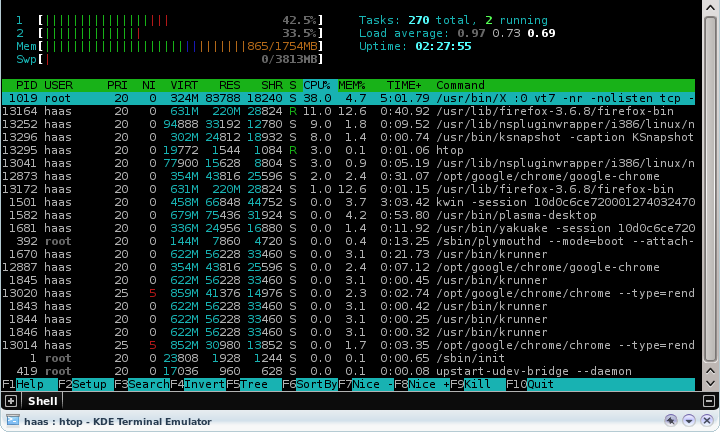
htop is a simple and wonderful tool to view the current memory usage on a Linux box. The tool is upgraded version of the top command, providing users some interactive menus and even mouse based control of sorting and menu access.

To install htop on your ubuntu system, execute the following command in a console:
sudo apt-get install htop
Run htop via a console.

Enhanced by Zemanta
Categories
Hardware Open Source Solutions Ubuntu

Playing DVDs in Ubuntu

Dvd-video-logo
Image via Wikipedia

Ubuntu by default does not play encrypted DVDs. This is because most commercial DVDs are encrypted with CSS (Content Scrambling System), which restricts the software that can play a DVD.

To enable you must install the libdvdcss2 package to allow Ubuntu to play DVDs. For that you need to run the following commands:

sudo apt-get install libdvdread4

Followed by:

sudo /usr/share/doc/libdvdread4/install-css.sh

That will install the required libraries and now your encrypted DVDs will be readable.

Please Note: Check with your local laws to make sure that usage of libdvdcss2 would be legal in your area.

Enhanced by Zemanta