Categories
Android Hardware Solutions

Galaxy Ace – Gingerbread Update – Stuck at “Setting Up Connection”

While flashing the Gingerbread update for Galaxy Ace (taken from samfirmware.com ) I encountered an interesting problem with my ODIN being stuck at “Setting Up Connection” message.

The problem I figured out later was a simple case of my phone being in the wrong mode. For updating you must be in the “Downloading” mode, In this mode the phone flashes a single line message on the screen – “Downloading…”


To get to this mode reset your phone(take the battery out, also take out your sim card and micro sd card). Hold Home, Volume Down and power buttons and then connect to the system.

VERY IMPORTANT: If you hold the Volume Up or both Volume buttons you will end up in other modes (like the ram dump mode).

Once in the more updating is just a few minutes affair 🙂


Categories
Device Hardware Laptop Linux Solutions Ubuntu

Getting the Latest Ubuntu Graphics Drivers on Samsung NC20

Official Ubuntu circle with wordmark. Replace ...
Image via Wikipedia

To get the best graphics performance out of your Samsung NC20, you will need to install the latest graphics drivers.  These drivers unfortunatey are not easy to find on the web, so here is a step-by-step installation instructions for driver installation on Ubuntu 10.10.  Special thanks to the wonderful folks at Ubuntu Forums(Wonderful source, thumbs up to the contributors).
{adinserter 2}
The steps explained below were taken from post #542 from this Ubuntu Forums page.

  1. Download this zip file via_chrome9_drv_u1010_v2.zip and unzip it
  2. Open a terminal window and change into that directory (“cd ~” for home dir)
  3. Install the “dkms” package from Ubuntu package repository
    $ sudo apt-get install dkms
  4. Install the kernel driver:
    $ sudo dpkg -i chrome9-drm_87a.55689-maverick1_all.deb
  5. Install the X.org driver:
    $ sudo dpkg -i --force-confmiss --force-confnew xserver-xorg-video-chrome9_87a.55729-maverick1_i386.deb
  6. Update /etc/X11/xorg.conf file
  7. Copy the provided xorg.conf.nc20 file to xorg.conf
    $ sudo mv /etc/X11/xorg.conf /etc/X11/xorg.conf.backup
    $ sudo cp /etc/X11/xorg.conf.nc20 /etc/X11/xorg.conf
  8. Reboot Ubuntu
  9. Check if it’s working: Open /var/log/Xorg.0.log in a text editor. If you see several lines containing “VIA(0)”, then the new driver is being used.

Also note:

  • The sample xorg.conf.nc20 is only installed if you add the “–force-confmiss –force-confnew” options to dpkg.
  • Although VIA marks the source code this hacked driver is based on as stable, I cannot guarantee it to be bug-free. Use with caution.
Enhanced by Zemanta
Categories
Solutions Windows

Protect your Thumb Drive from Viruses using a Simple Hack


One of the easiest ways for getting your system infected with viruses is by using infected thumbdrives.  Most viruses create a startup file with the name “autorun.inf” and in the file point to the location of the virus(within the drive) to be run automatically when the thumb drive is detected.

Most Antivirus programs detect these viruses but there is a simple hack that can be used to prevent these Autorun viruses from infecting your drive.

All you need to do is:

  1. Delete the “autorun.inf” file in the root folder of your thumb drive(if the file exists)
  2. Create a new folder with the name” autorun.inf” in the root folder of the thumb drive

How does this work?
Well most viruses create the autorun.inf file when the thumb drive is inserted, by creating a folder with the same name the virus cannot create the file. Also since its a folder its not straightforward to delete and replace it(thank you Fat32 filesystem)

Ps: This hack works with most common viruses but its still recomended that you have an updated antivirus program to faithfully protect your system against virus attacks.

Enhanced by Zemanta


Categories
Open Source Solutions

Bulk Edit Photos using Phatch

Phatch Mascot & Logo
Image via Wikipedia

Phatch is a simple to use cross-platform GUI Photo Batch Processor which handles all popular image formats. Phatch can batch resize, rotate, apply perspective, shadows, rounded corners, … and more in minutes instead of hours or days if you do it manually. Phatch allows you to use EXIF and IPTC tags for renaming and data stamping.

Phatch is an incredible tool to quick fire batch processing of photos. I use it most commonly to resize images to a fixed size, for example while uploading images its preferred to have a good resolution but not as high as what the digital camera provides. I use Phatch to reduce the resolution of the photos in the photo set and then upload the images. This saves a lot of time and bandwidth.

Using Phatch is simple but might confuse a newbie. Here is a simple startup guide to Phatch.

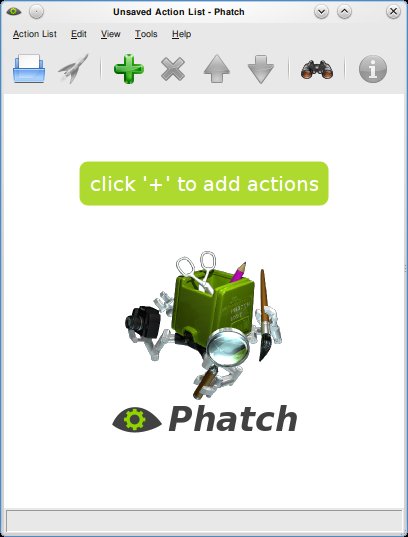
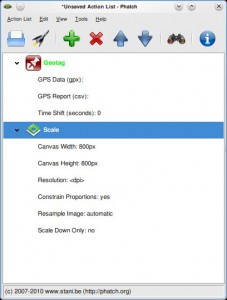
  • Run Phatch and the screen below will show up.

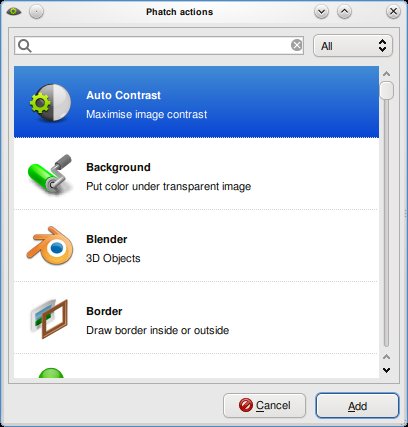
  • Click on the ‘+’ sign to add actions, you can choose from a plethora of options. You can use the resize option to resize images ect.
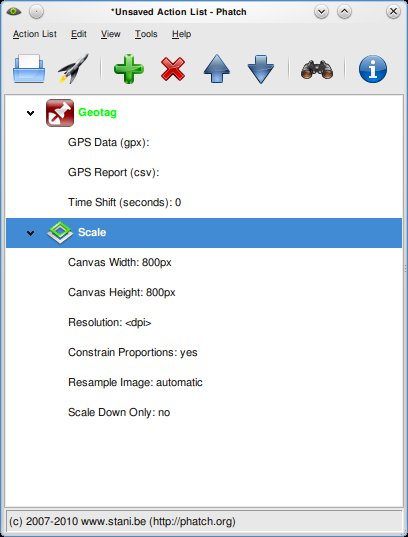
  • Once the options are selected you will need to put a save option at the end, this will save the file for you. You can choose the name, format and other options here.
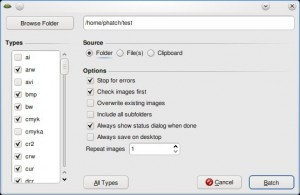
  • Hit the rocket ship button to start processing. A dialog will ask you details of the file to be processed and where it must be saved. Once done hit the ‘Batch’ button and wait till Phatch tells you its done processing the images.
To install Phatch on Ubuntu, use the following command:
sudo apt-get install phatch

You can download the installation file for Windows and other Operating Systems here

Enhanced by Zemanta
Categories
Linux Solutions Ubuntu

Solve Choqok’s Twitter Connectivity Problems…

This file is created by Roozbeh Shafiee for Ch...
Image via Wikipedia

Choqok the new and impressive micro-blogging client for KDE is one of the best clients for microblogging sites. The tool available via the default repositories of Ubuntu does not support the latest OAuth authentication of Twiiter. This means that it wont be able to connect to twitter.

You will need the latest version of Choqok to be able to reconnect to twitter. This can be done as shown below

  • Open the Konsole and execute the following commands:
  • $ sudo add-apt-repository ppa:adilson/experimental

    $ sudo apt-get update

    $ sudo apt-get install choqok

  • Once installed you will need to reauthenticate your twitter feeds.
    Select the Settings -> Configure Choqok menu item
    In the Accounts tab remove all the old twitter accounts and add them back again
    For each account you will be taken to twitter.com to give permission for Choqok to access your data
    Once done you will get a number, copy-paste the number back in Choqok dialog to get Choqok working again.

The new Choqok also has added features of auto-complete for friend names and better integration with url shortening sites.

Enhanced by Zemanta