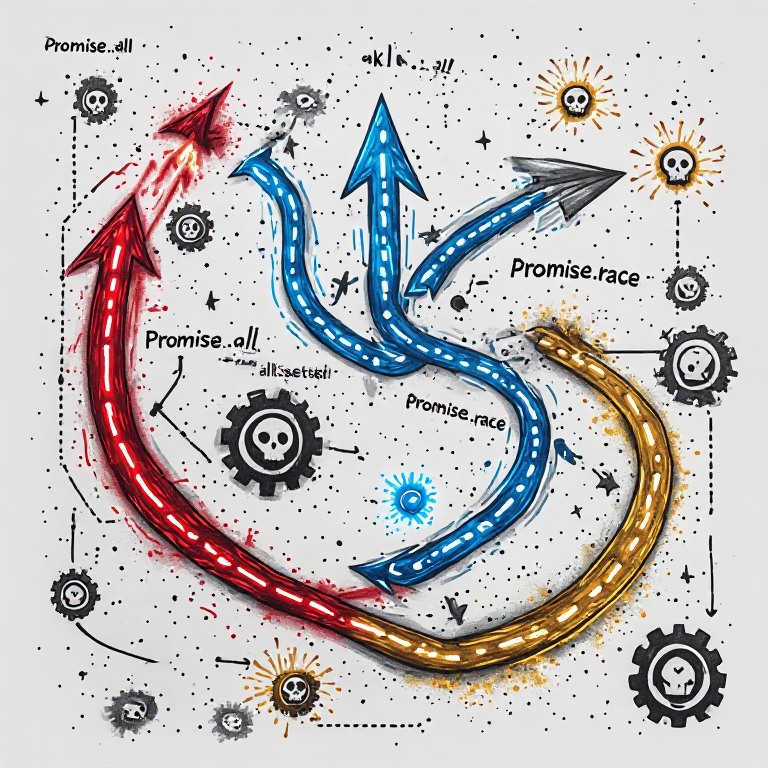
Managing complex asynchronous execution operations is a fundamental requirement when building responsive web software. To build reliable systems, a thorough understanding of advanced concurrency architecture is essential. This JavaScript promises deep dive explores the precise operational behaviors, failure profiles, and performance characteristics of modern async control flows.
When handling multiple network inputs or server requests, executing operations sequentially can introduce costly latency blocks. Consequently, utilizing native promise combinators allows engineers to run microtasks concurrently. This strategy significantly improves application efficiency and interface speeds.
To see how secure client-to-server messaging streams handle data routing before diving into these local promise arrays, read our architectural guide on Electron React IPC Communication.
1. The All-or-Nothing Paradigm: Promise.all
The Promise.all method is the most frequently used concurrency tool in modern web applications. Specifically, it accepts an iterable array of pending actions and attempts to resolve them in parallel.
Therefore, it is ideal for loading dependent database collections simultaneously. For example, you can fetch a user profile and an app configuration pool at the same time:
JavaScript
// Simulating concurrent API data streaming operations
const fetchUserProfile = () => new Promise(res => setTimeout(() => res({ id: 101, user: "Chandra" }), 150));
const fetchSystemConfig = () => new Promise(res => setTimeout(() => res({ theme: "dark", lang: "en" }), 100));

async function loadApplicationData() {
  try {
    // Initiate execution arrays concurrently
    const [profile, config] = await Promise.all([fetchUserProfile(), fetchSystemConfig()]);
    console.log("Application initialized successfully:", profile, config);
  } catch (error) {
    console.error("Initialization halted due to a critical dependency failure:", error);
  }
}
loadApplicationData();
However, you must remember that Promise.all implements a strict short-circuit rejection policy. If even one element in your collection fails, the entire batch rejects instantly. Consequently, any successfully completed actions in that array are completely disregarded by the top-level catch block.
2. Defending Against Failures: Promise.allSettled
When you want to execute multiple independent requests without allowing a single failure to disrupt the remaining operations, Promise.all is inadequate. In contrast, you should use Promise.allSettled.
This combinator executes all tasks completely, regardless of individual outcomes. Afterward, it returns an array of structural objects describing the exact resolution status of each separate action:
JavaScript
const uploadImageA = () => Promise.resolve("Image A stored on cloud server.");
const uploadImageB = () => Promise.reject(new Error("Cloud storage upload timeout."));

async function processMediaQueue() {
  const uploadBatch = [uploadImageA(), uploadImageB()];
  const executionResults = await Promise.allSettled(uploadBatch);

  // Inspect the structural outcome matrix cleanly
  executionResults.forEach((result, index) => {
    if (result.status === "fulfilled") {
      console.log(`Task ${index} Succeeded:`, result.value);
    } else {
      console.warn(`Task ${index} Failed:`, result.reason.message);
    }
  });
}
processMediaQueue();
Therefore, this pattern is highly recommended for multi-file upload management or secondary logging analytics operations.
3. Racing to the Finish: Promise.race vs Promise.any
The remaining two core combinators focus entirely on speed rather than collective completion. However, they evaluate their internal resolution states using completely opposite conditions.
- Promise.race: This method resolves or rejects the moment the very first promise in the array changes state. As a result, it is highly effective for setting strict network timeout boundaries on slow remote connections.
- Promise.any: In contrast, this method targets the first successful resolution. It ignores failures completely unless every single item in the iterable array rejects. If that total failure occurs, it returns an AggregateError wrapper.
JavaScript
// Setting an operational network timeout boundary using Promise.race
const longRunningQuery = () => new Promise(res => setTimeout(() => res("Data payload fetched."), 5000));
const networkTimeoutGuard = () => new Promise((_, rej) => setTimeout(() => rej(new Error("Gateway Timeout")), 2000));

async function executeBoundedRequest() {
  try {
    // Whichever task completes first establishes the final state
    const executionOutput = await Promise.race([longRunningQuery(), networkTimeoutGuard()]);
    console.log("Query completed within acceptable limits:", executionOutput);
  } catch (error) {
    console.error("Operation terminated safely:", error.message);
  }
}
executeBoundedRequest();
To cross-reference core microtask mechanics, event loop specifications, and memory management rules directly from standard engineering authorities, check out the MDN Web Docs Promise Reference Guide.
JavaScript Promises – FAQ (Frequently Asked Questions)
avaScript operates on a single-threaded execution model. Therefore, promises do not run in multi-threaded parallel pathways. Instead, asynchronous web requests are handed off to external browser web APIs or underlying system worker engines. Consequently, these tasks run concurrently in the background and return data packets to the main microtask queue as they complete.
A promise exists in one of three distinct phases. First, it starts as pending while the background action runs. Next, it shifts to fulfilled when the operation completes successfully and returns a data payload. Finally, it moves to rejected if the background task encounters an unhandled runtime error or timeout configuration restriction.
Using async/await structures is highly recommended when handling sequential operations that rely on variables from previous scopes. It makes complex asynchronous workflows read like clean, standard synchronous text blocks. In contrast, long chains using .then() can quickly lead to nested layout confusion and complicate runtime debugging practices.