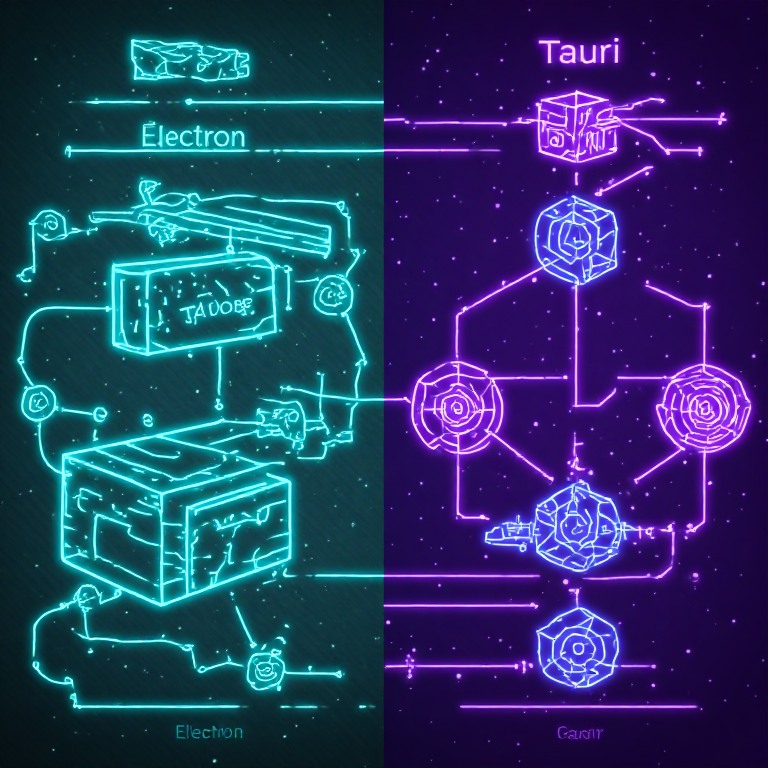
Choosing the right architectural foundation for cross-platform desktop application development is a critical engineering decision. For years, GitHub’s Electron framework has been the undisputed industry standard for compiling web-based applications into native desktop environments. However, Tauri has emerged as a formidable challenger, promising to solve many of Electron’s historical pain points.
When evaluating electron vs tauri, frontend engineers and architecture leads must look past hype cycles. You need to weigh tangible engineering tradeoffs: runtime resource constraints, security boundaries, bundle configurations, and distribution complexity.
📦 Bundle Size and Memory Footprint
The most immediate differentiator between these two ecosystems is resource consumption.
Electron packages an entire instance of the Chromium browser rendering engine and a complete Node.js runtime environment inside every single executable file. Because of this architectural design, even a basic “Hello World” application built with Electron starts at a baseline bundle size of roughly 100MB to 120MB. Furthermore, it consumes a significant amount of RAM—often sitting at 60MB to 100MB+ at idle—because it handles full browser execution processes in the background.
Conversely, Tauri swaps out Chromium in favor of the operating system’s native Webview layer via a library called WRY (utilizing WebKit on macOS/Linux and WebView2 on Windows). Because it pulls the host OS engine instead of shipping its own, a standard Tauri binary can weigh in at a lean 2MB to 5MB. Since it relies on optimized native OS components, its idle RAM usage regularly hovers around 20MB to 40MB, providing a significantly lighter footprint for end-users.
🦀 The Runtime Environment: Node.js vs. Rust
The core architectural backbones of these frameworks require completely different mental models:
- Electron (Node.js Core): Electron uses JavaScript and Node.js for its main process. This provides a unified language stack across the front and back end, giving developers instant access to the massive npm package ecosystem.
- Tauri (Rust Core): Tauri uses Rust for its core system process. While this introduces a steeper learning curve for teams without systems programming experience, it delivers memory safety, execution speed, and efficient thread concurrency.
🔒 Security and Isolation
Security posture is another area where the two frameworks diverge significantly. Electron applications require meticulous configuration to prevent Cross-Site Scripting (XSS) vulnerabilities from turning into full remote code execution exploits. If an attacker gains script execution capabilities inside a renderer process that has nodeIntegration enabled, they inherit complete access to the underlying filesystem and shell tools.
Tauri enforces a strict security-first framework layout by default:
- Isolation Pattern: It prevents the frontend from accessing the backend directly without explicit permissions.
- Explicit Capability Lists: Frontend assets can only interact with system APIs through tightly controlled, pre-configured command allowances.
- No Node.js Exposure: Because Node.js is completely absent from the client-side execution path, standard web exploits cannot easily break out into native system access points.
When preparing internal production setups or designing real-time client monitors, maintaining a clean developer environment is essential. Be sure to process your configuration schemas, environment vars, and JSON parameters directly through our localized /tools/ suite to keep your pipeline efficient.
Yes, in terms of startup performance, bundle size, and memory efficiency, Tauri outperforms Electron. Because Tauri uses the operating system’s native WebView instead of bundling a full Chromium engine, it uses significantly less RAM and CPU at runtime.
Absolutely. Both frameworks are entirely agnostic when it comes to frontend technology stacks. You can seamlessly integrate React, Next.js, Vue, Svelte, or vanilla HTML/CSS/JavaScript with either Electron or Tauri.
Choose Electron if your application relies heavily on complex node-native (.node) C++ dependencies, requires broad legacy OS support, or if your team needs to ship rapidly using an all-JavaScript stack without learning Rust.